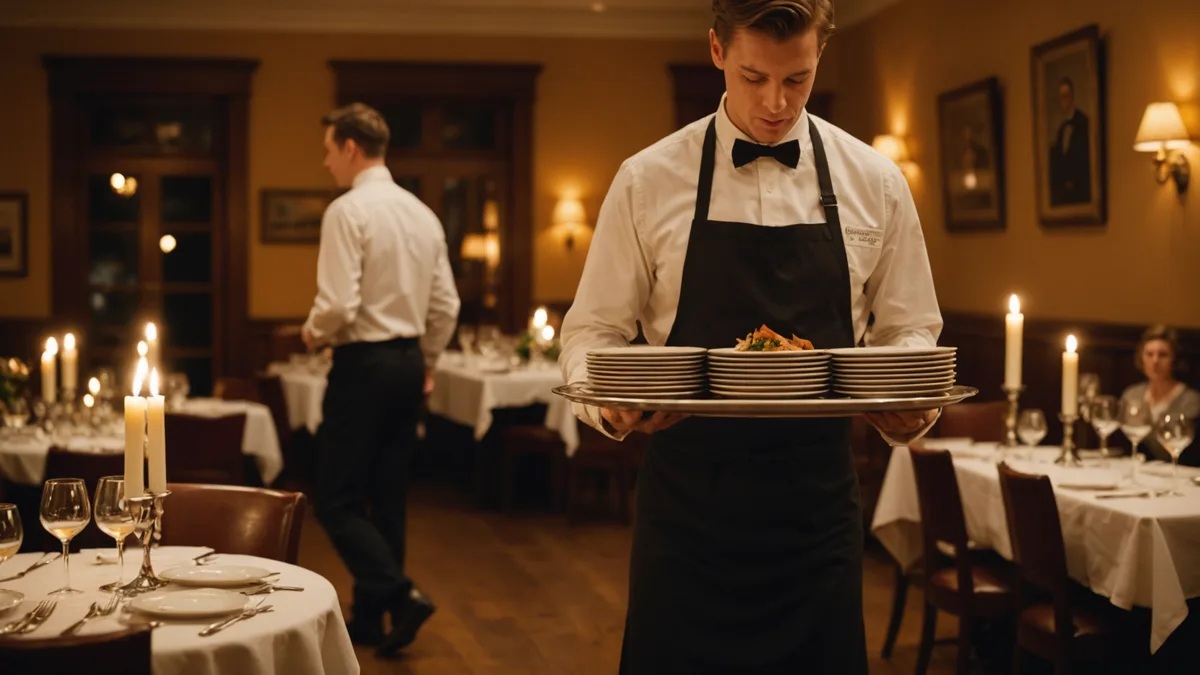
Ask any restaurant server or bartender which part of their job during peak service they like least, and the phone comes up consistently. The exact words vary. "It takes me out of what I'm doing." "I have three tables and nobody else is going to get it." "I pick up and the person asks something I have to walk to the kitchen to find out anyway." The underlying experience is the same in every restaurant: the phone interrupts at the worst possible moment and creates friction that radiates outward well past the call itself.
The intuitive response from owners is often frustration: "Just answer the phone, it's part of the job." That response misses the structural reality of service. Staff are not refusing to answer the phone because they are lazy or indifferent to guest experience. They are making a real-time triage decision that the four people at their tables take priority over the person on the phone, which is usually the right decision. The problem is that both things matter, and there is no good way to handle both at the same time.
The Actual Disruption Mechanics
Understanding why the phone is so disruptive requires understanding what restaurant service requires mentally, not just physically. A server managing three or four tables during dinner service is holding an active mental model of each table's state: what has been ordered, what has been fired, when each course should arrive, who needs attention, and which tables are approaching the point where the check conversation should happen. This is a genuine cognitive load, held simultaneously, updated continuously.
When a phone call interrupts this, the server cannot press pause on those four tables. The tables keep progressing through their meals. Guests are making decisions about whether to flag someone down. The kitchen is firing courses. Meanwhile, the server is on the phone navigating a conversation that may have nothing to do with any of the people they are physically responsible for.
When they hang up and return to the floor, their mental model of each table has degraded. They missed what happened in the 90 seconds they were gone. Re-synchronizing takes two to three minutes of careful attention before they are fully back in the state they were in before the call. Research on attention and task-switching supports this: the cost of an interruption is not the duration of the interruption, it is the time required to re-engage fully with the interrupted task. For complex multi-task environments, that re-engagement cost is consistently several times larger than the interruption itself.
The Morale Dimension
Beyond the cognitive disruption, there is a morale dynamic that compounds over the course of a shift and over repeated shifts. Servers who are regularly pulled off the floor to answer the phone during busy service develop a specific kind of frustration with the task.
Part of it is the experience of being in two places at once. When you are on the phone for a takeout order, your tables are unattended. You know they are unattended. You know the guest at table seven wants to ask a question and you are stuck on hold while a caller figures out what they want to order. The awareness of what you are not doing compounds the frustration of what you are doing.
Part of it is the lack of any buffer. In most small restaurants, there is no system for managing who is on phone duty. The phone rings and the person nearest to it, or the person who gives in first, handles it. This creates an uneven distribution where certain staff end up fielding more calls than others, and where the phone becomes associated with whoever happened to be in the wrong place at the wrong time. That association builds resentment over time.
The behavioral result shows up reliably: calls start getting answered with noticeably less warmth as the shift progresses, and staff begin letting calls ring longer before picking up, hoping a colleague will get there first. Both behaviors directly hurt guest experience, both for the guest on the phone and for the guests watching their server run to answer a call at a bad moment.
The Caller Experience Reflects This
When a server answers the phone mid-service under pressure, the caller can often tell. The greeting is short, the voice is tight, and the energy communicates "I need this to be quick." For a caller who is trying to ask about large party options or wants to talk through a dietary restriction, that energy closes down the conversation before it opens.
The guest's first phone interaction with a restaurant is often a formative impression. If that impression is a harried server who sounds like they want to get off the phone, the implicit signal is that this restaurant does not have time for the caller. That impression may be totally unfair to the restaurant, which is simply dealing with a structural conflict, but the impression forms regardless of intent.
The phone as a service touchpoint is therefore degrading at exactly the moments when the restaurant's service quality matters most, because the conditions that create service quality pressure (a full room, a busy kitchen, high guest expectations) are the same conditions that degrade the phone experience.
What a Manager Can Observe
If you are not sure whether the phone is causing disruption in your restaurant, there is a simple observation to make during one dinner service. Notice how your staff respond when the phone rings. Do they move toward it or do they each wait for someone else to go? Does the person who ends up answering show visible frustration or tension? How long does it take them to visibly return to full focus on their tables after the call ends?
These are not disciplinary observations. They are diagnostic ones. If what you see matches the pattern described here, the phone is costing you more than you can see on a report, both in service quality for guests in the room and in staff wellbeing over the course of a shift.
Removing the Phone from the Floor Equation
The response we hear most often from restaurant owners thinking about this problem is: "I just need staff who are better at multitasking." That is not a solvable constraint. Human attention is finite, and the specific demands of restaurant service during peak hours already require near-maximum attention. Adding "also answer the phone professionally and without appearing rushed" to the requirements of dinner service is asking for something that conflicts with the other requirements in the job at that moment.
The structural fix is to take the phone off the floor during service hours. When Loman handles calls, nobody on the floor hears the phone ring. The call is answered, handled, and a notification arrives at the right time in the right format. The server's mental model of their tables is never interrupted. The floor stays in its own operational bubble during service.
The behavioral change that results is not dramatic but it is consistent across the restaurants we have worked with. Within the first week, staff stop orienting toward the phone when it would have rung. The ambient background tension of "someone needs to get that" dissipates. Staff report that service feels less fractured, not because anything changed about the floor itself, but because one interruption source was removed from the equation.
We are not claiming this solves all of the operational pressures of a busy dinner service. There are plenty of stressors in restaurant work that have nothing to do with the phone. But the phone is a specific, tractable problem with a direct cost to service quality and staff morale that can be addressed cleanly. Removing a specific stressor is not the same as removing all stress. It is just the right place to start.